Honoring those who died while serving the country this Memorial Day extends to some local young athletes and Arizona Wildcats who fought in various wars.
Graham Watson of Yahoo Sports wrote in 2015 a gripping, emotional story about the loss of popular former Tucson High School and Arizona Wildcats baseball star Chris Moon, a war hero killed in Afghanistan at age 20 in 2009.
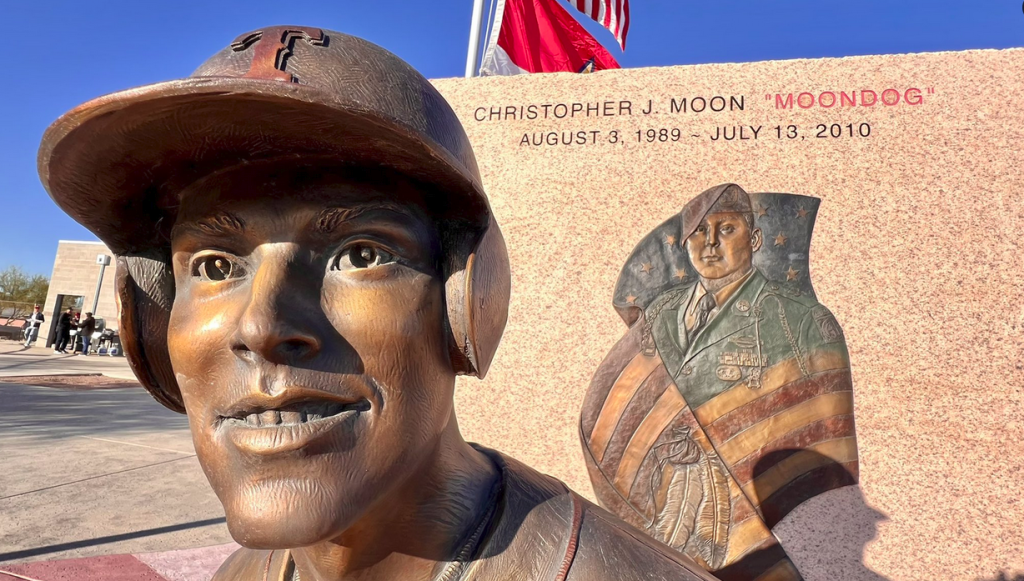
A memorial for Moon overlooks the baseball diamonds at Cherry Field in Tucson. Moon’s future appeared to be in baseball as a late-round draft choice by the Atlanta Braves in 2007. He opted to play for the Arizona Wildcats instead of going pro but never had the chance to play for head coach Andy Lopez.
The Chris Moon Memorial at Cherry Field, where his alma mater Tucson High plays (Andy Morales/AllSportsTucson.com)
A semester into attending Arizona, Moon decided to join the Army instead. Less than two years after telling Lopez his mind was made up to serve his country rather than play baseball, Moon, who quickly became a highly efficient sniper, lost his life as a result of being close to a bomb that was remotely detonated by a member of the Taliban.
“I don’t want to define him by his death. I define his life by how he lived and the kind of person he was and the good things that people tell me about him because obviously as a parent, the most important thing is what people tell you that he’s doing when you’re not around. That’s what defines what kind of child you have.” — Brian Moon, Chris’ father, as quoted by Graham Watson of Yahoo Sports
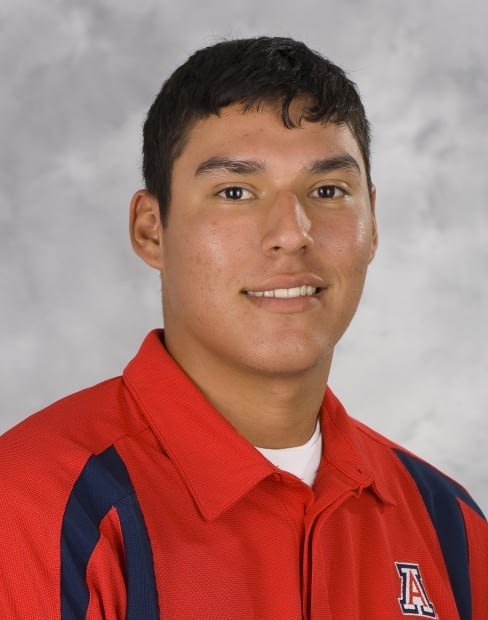
Chris Moon during his freshman year at Arizona in 2007-08
“It was hard to imagine somebody giving up what he had to go serve our country,” Tucson High’s head athletic trainer Mike Boese told Watson. “I always tell people, Chris Moon was the high school/college version of Pat Tillman.”
Moon earned Southern Arizona Player of the Year honors as a pitcher and center fielder at Tucson High School. Lopez told Graham that Moon could have played professional baseball if he stayed at Arizona for three years.
Despite his success on the baseball diamond, Moon asked his father Brian since he was 16 if he could join the military. His father was very much against the idea, believing Chris already had a challenge to overcome as a college student and baseball player. As Chris persisted about joining the Army in his first semester at Arizona, his father finally relented.
William “Bill” Lowell
Three members of the Arizona’s 1942 football team served in World War II and were killed in action.
In 2008, the Arizona Wildcats’ athletic department dedicated a memorial that was built to honor William “Bill” Lowell and fellow teammates from the 1942 football team who served in World War II. Lowell and teammates Rue Mattice and Stanley Petropolis played on the 1942 Arizona football team, served in World War II and were killed while in battle.
The Bill Lowell Memorial is adjacent to the Richard Jefferson Gym on Arizona’s campus (Arizona Athletics)
Petropolis, 26 at the time of his death, was one of 19,000 American soldiers killed in the Battle of the Bulge, an attack by Germany on France, Belgium and Luxembourg on Jan. 26, 1945. From East Chicago, Ind., Petropolis was an All-Border Conference selection as an offensive lineman his junior season in 1942.
Lowell served in the U.S. Marine Corps and died during the battle of Iwo Jima, a monthlong conflict that killed more than 6,800 Americans. Lowell was killed on March 8, 1945, two weeks past his 22nd birthday.
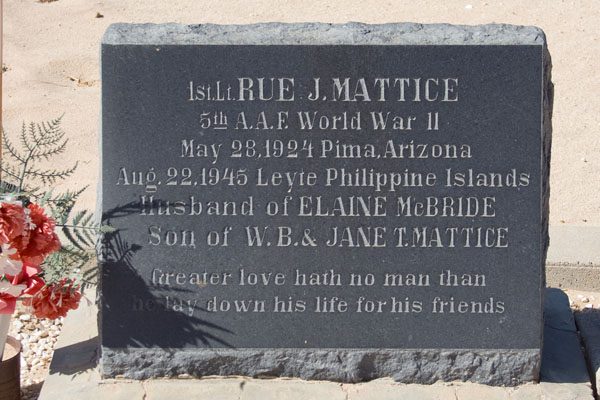
Arizona football player Rue Mattice perished during World War II when the C-46 transport plane he was piloting had engine failure and crashed in the Philippines.
Mattice, a First Lieutenant in the U.S. Army, died shortly after Japan announced it would surrender, flying transport in the Phillippines when he lost power to both engines. He died at age 22 on Aug. 22, 1945. He was posthumously awarded the Distinguished Flying Cross.
The memorial on the Arizona campus was inspired by J. David Lowell, Bill Lowell’s younger brother and a significant university benefactor. Lowell donated $2.5 million in capital funding toward construction of the Arizona basketball/volleyball practice facility northeast of McKale Center. J. David passed away in 2020 at age 92.
The gravestone of former Arizona football player Rue Mattice (Mattice family photo)
The memorial – which features a life-size bust of Bill Lowell – is located west of the entrance to the Richard Jefferson Gymnasium.
Arizona didn’t field a football team in 1943 and 1944 because of World War II. David Lowell played one season, for the 1945 team that went 5-0. He ended his career prematurely to concentrate on his studies. He became one of the world’s leading experts in mining exploration.
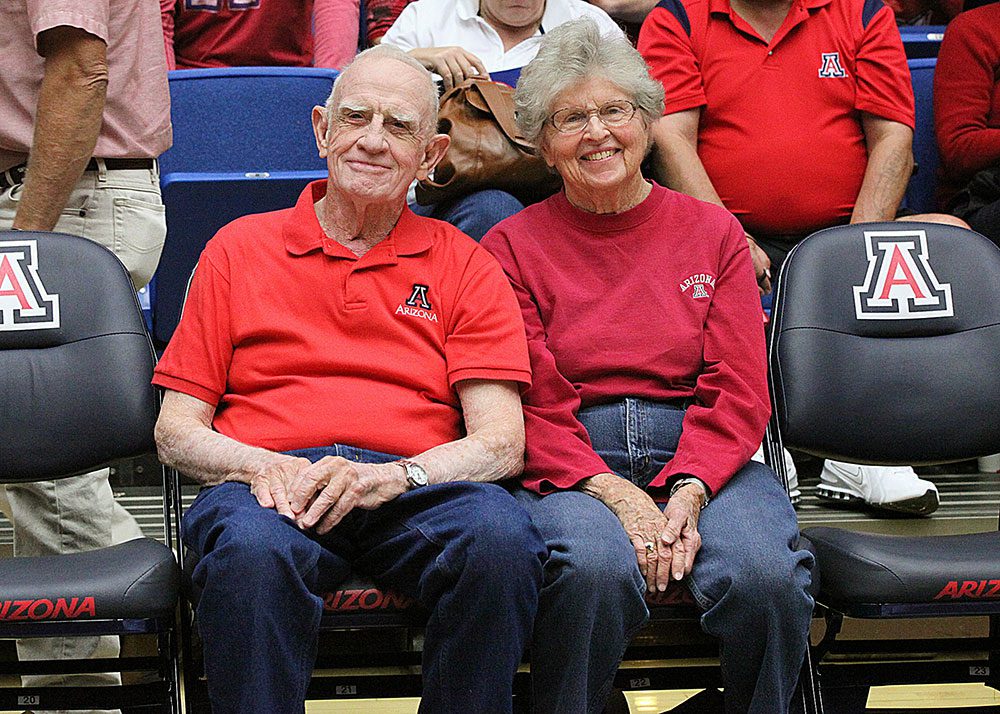
David and Edith Lowell (University of Arizona photo)
The relatively Lowell-Stevens Football Facility was funded in part by David and Edith Lowell. They pledged $11 million to its development. Jeff and Sharon Stevens donated $12 million to get the project started.
Former Arizona offensive lineman Stanley Petropolis, who died in 1945 in the Battle of the Bulge
Other notable former Arizona Wildcats survived through their service in World War II.
John R. Black, who lettered at Arizona from 1938-40, was one of them.
Black, who passed away at age 84 in 2004, graduated from Tucson High School in 1937 and Arizona in 1942. He was first team All-Border Conference in 1939 and 1940 and was captain in 1940 as quarterback and defensive back. Arizona was fifth in the nation in total offense in 1939. Black also lettered three years in basketball as starting guard. He was inducted into the Arizona Sports Hall of Fame for football and basketball in 1979.
In 1942, Black entered the Navy as Ensign and attended the U.S. Naval Academy and was assigned to service at Corpus Christi Naval Air Station and then to an aircraft carrier in the Pacific from 1942-1946. Black saw action in the Lingayen Gulf Invasion and was hit by a suicide bomber. He was in Okinawa and then Tokyo Bay when the peace treaty was signed. He was discharged in January 1946 as Lt. Senior Grade.
Three other local young men, including a sportswriter and boxer, lost their lives in World War II.
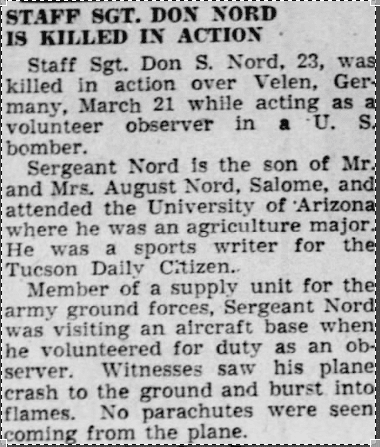
U.S. Army Staff Sgt. Don Nord was 23 when he was killed in action during World War II in 1945
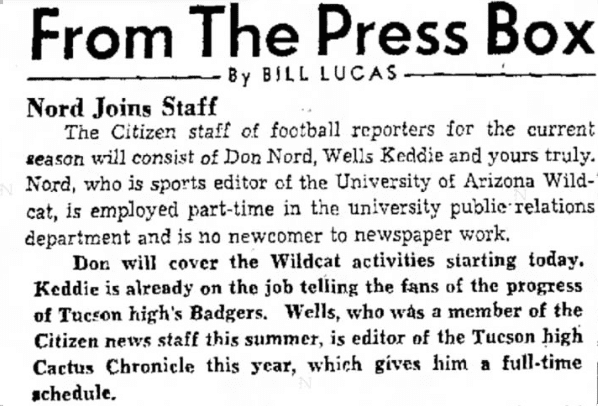
Staff Sgt. Don Nord was shot down on March 21, 1945 over Velen, Germany on a volunteer mission. He was one year away from attaining his degree from Arizona and he was a sportswriter for the Tucson Daily Citizen and the Sports Editor for the University of Arizona Wildcat.
Nord entered the Army in December of 1942 and reported for active duty on Dec. 5, 1943. He served with the 84th Reconnaissance Troop with the 84th Division. He was a member of a supply unit for the Army ground forces and was visiting an aircraft base in March of 1945, when he volunteered to fly with the crew.
On March 31, 1945, Nord was the designated gun observer on the plane. They departed from Couvron, France with their destination of Dulmen, Germany. The plane was number 2 in position. It was hit by flak and crashed to the ground in Velen. All three of the crew members were killed on impact.
Tucson Citizen clipping
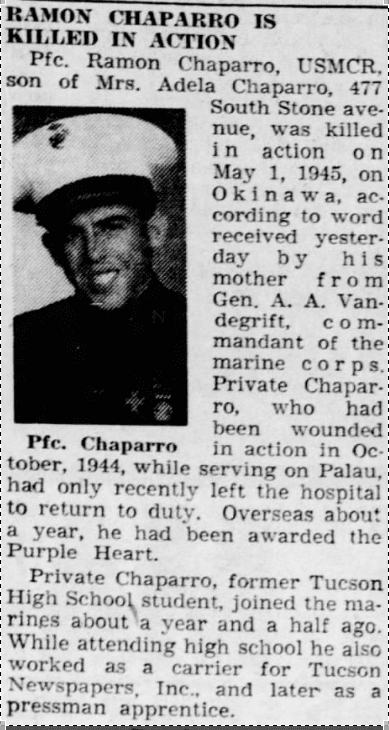
Pfc. Ramon Chaparro was killed in action on May 1, 1945 on Okinawa. He had just returned to duty after being wounded in action. He was a pressman apprentice with Tucson Newspapers, Inc. while attending Tucson High.
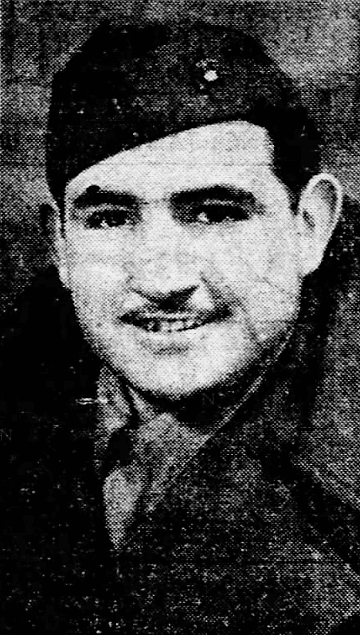
William Contreras Cocio (Tucson Citizen clipping)
Cpl. William C. Cocio was fatally wounded on Saipan on June 17, 1944. The state golden gloves light heavyweight boxing champion from 1938 to 1940, Cocio won 22 bouts while competing for the Marine Corps. Five Cocio brothers served in war – William, James, Manuel, Arturo and Eddie.
Cocio as an All-Star baseball player for Tucson High and he was part of the Arizona Junior Cowboy Softball state championship team of 1938 and the Tucson High state baseball championship teams of 1939 and 1940. His Badger and Junior Cowboy teammates were University of Arizona baseball and basketball standout George Genung and legendary football standout Fred Enke, Jr.