
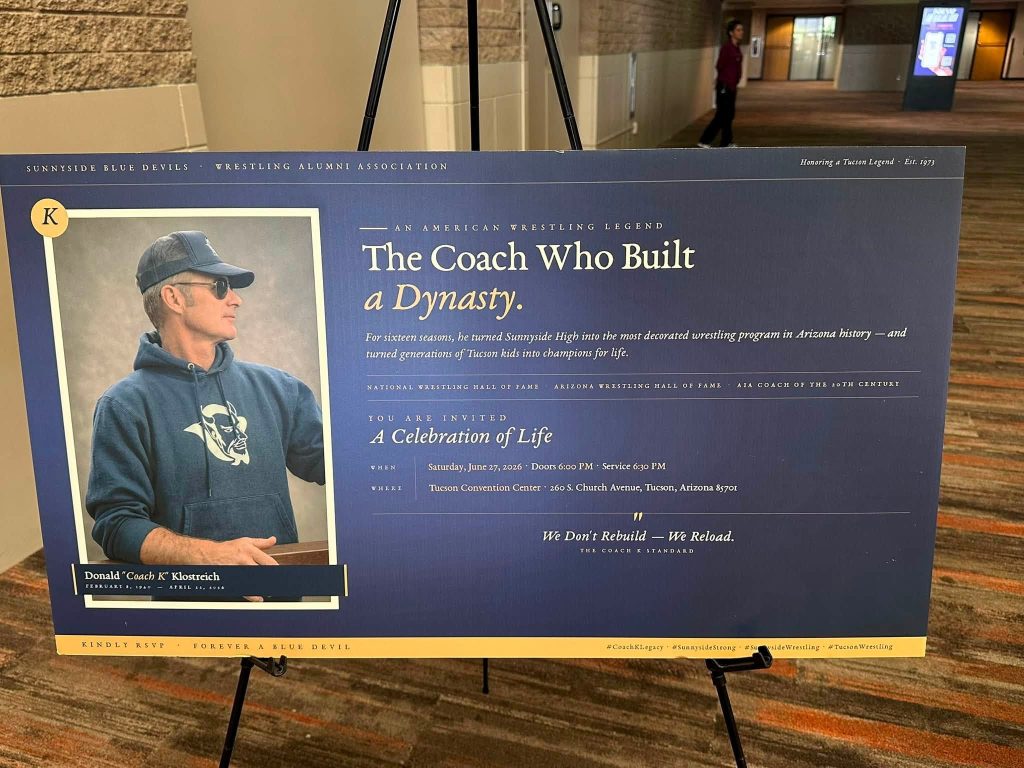
Don Klostreich’s coaching success in wrestling, built on toughness and, yes, compassion, came from his upbringing, not just his knowledge of the sport.
He was raised on a farm in Minot, N.D., often living through hardships with his family, including times without electricity or running water.
That childhood background was at the root of what generated the stern, yet endearing, personality of a coach who experienced a distinguished career unlike any other in the state’s history.
“Picture this,” his widow Faith said, “early every morning, young Donnie climbed up on his horse and rode to school, a one-room schoolhouse on the open plains. That horse’s name was Champ. He didn’t know it then, but he was already riding toward everything he would become back then.”
Her words captivated those in the grand ballroom at the Tucson Convention Center on Saturday night the same way Klostreich’s military-general appearance demanded attention from his wrestlers when he walked into Sunnyside’s wrestling room.
The Godfather of Sunnyside’s wrestling dynasty, one that is at 39 boys state titles and two girls state championships and counting, was honored in a celebration of life ceremony following his passing in April at age 86.
Jet Sports Training owner Bobby Rodriguez, a Class of 2007 Sunnyside graduate, organized the event with the help of Tucson City Ward 5 Council member Selina Barajas, who made the ballroom available.
“It’s now my responsibility as a business owner, as a founder of Jet Sports Training, to continue to serve with ethics, lead with ethics, because at the end of the day, you cannot stop giving back,” Rodriguez said. “That’s one thing that I learned from Sunnyside, and one thing I learned from Coach Klostreich, even though he was not my coach, is you can’t stop loving.
“At the end of the day, I know he loved his wrestlers. He loved his athletes, and he loved his community. So it’s my responsibility to take a little bit of what he left behind and continue the legacy.”
Rodriguez placed at every table a placard that listed a coach’s creed by Klostreich:
— Be there
— Be on time
— Be prepared
— Be coachable
— Improve
Klostreich transformed the program at Sunnyside into one of the most dominant wrestling powerhouses in the nation after arriving at the school in the fall of 1973.
“From that North Dakota farm, a young man emerged who was more ready than he could have known for the long life that laid ahead. His spring planted the seeds, summer revealed the strength of the roots that held firm through the rain. When Don was about 12 years old, the family lost all of their cows to disease. They had to sell the farm and move to town. Suddenly he had the chance to go to work on another kind of field and seasons took on a whole new meaning. Don became an athlete in the fullest sense of the word, football, wrestling, track, boxing. He didn’t participate, he competed, and he brought to every sport what the farm had already given him an absolute refusal to quit, and the deep knowledge that preparation is simply respect for the moment when it really counts.” — Faith Klostreich
Klostreich earned a bachelor’s degree in education from Jamestown College where he was a standout on the Jimmies’ football, wrestling, and track teams. He became a graduate assistant at Jamestown before becoming an assistant at the University of North Dakota, where he earned a master’s degree in physical education. He also worked as a wrestling referee for local high school meets during his time at North Dakota. Later in life, he earned an additional master’s from Northern Arizona University.
Before attending North Dakota, Klostreich led Minot High School to three state championships.
He learned of an opening for the head football coaching position at Carl Hayden High School in Phoenix because of a coaching connection. That move was one of the first dominoes to fall that brought him to Sunnyside. One of his assistant coaches at Hayden was Paul Petty, who later became a legendary football coach at Sunnyside. Klostreich was fired from his job at Hayden after throwing a punch at a coach of a rival school during a coaching conference, in which the opposing coach made degrading comments about Klostreich’s players.
Petty was at Sunnyside by then and recommended Klostreich to Sunnyside’s brass to fill the wrestling coach vacancy in 1973.
“The years when a young man finds out what he’s truly made of, Don found out he was made of something remarkable. Autumn is the most vivid season, the most colorful, and the harvest sometimes reveals that difficult conditions can still produce the sweetest fruit. Autumn is when Don Klostreich became Coach K, and Coach K gave away everything the farm and the arena had given him. He poured it into young people who had little idea of what they were really capable. He was demanding because he had seen what demand produces. He was hard on his players because he was hard on himself. He didn’t just coach sports, he coached lives. Ask anyone in this room who played for him or worked alongside him, there is something that they still carry, something that comes back in the moments they need it most. And for every time he told one of his athletes to suck it up. I guarantee he told his kids, and his grandkids, and his wife the very same thing. In fact, we joke that suck it up should be our family motto.” — Faith Klostreich
In his 15 years at Sunnyside, Klostreich built a winning culture defined by nine state championships and 40 individual titles.
He led the Blue Devils to their first 5A state title in 1979 and followed that with an eight-year run of titles from 1981 to 1988. When he took over, Sunnyside had only four individual state championships. The Blue Devils are now at 205.
Saying he needed a break and change of scenery, Klostreich coached briefly in California before moving to Yuma, where he coached at Kofa High School. That’s where he met Faith, who was an English teacher and girls volleyball and girls basketball coach. They were married the last 35 years.
The Sunnyside dynasty was born under him and it has thrived under the coaches who followed him — Richard Sanchez, Robert DeBerry and Anthony Leon.
Legendary wrestling coach Bobby DeBerry, whose 15 state championships at Sunnyside are the most in the state’s history, talks about the late Don Klostreich’s everlasting impact on him and the sport in general. DeBerry is now the girls wrestling coach at Mountain View, and his son… pic.twitter.com/HDDq0nUg3q
— Javier Morales (@JavierJMorales) June 28, 2026
“He was real good with taking care of kids and motivating kids,” Sanchez recalled from when he served as Klostreich’s top assistant. “Whatever he told me, I took it like it was written in the Bible.”
DeBerry never coached with Klostreich, but he coached against him when DeBerry led Canyon del Oro’s program toward the tail end of Klostreich’s time at Sunnyside.
He called the times he matched wits against Klostreich “pretty intense,” but as time went on after Klostreich was in Yuma, the two of them became friends and talked weekly.
“The biggest thing that sticks in your mind when you hear his name is he’s synonymous with doing the right thing, pressuring, and putting your whole heart and soul in what you want to do,” DeBerry said. “As a coach, (Klostreich was responsible for) setting the tone for how a practice should be run — all eyes on me, and having the kids understand that, ‘I’m hard on you, but hard on you in order for you to be successful.’
“Also, it’s not just wrestling, it’s life.”
DeBerry recalled a horse metaphor Klostreich gave to him after Sunnyside finished second in his first year following Sanchez’s five-year run of state championships. After winning his first title in 1996, DeBerry’s team was runner-up again in his third year as head coach.
“That’s when (Klostreich) called me and said, ‘Hey, look, you have to do what you have to do. It’s your horse. Ride it,'” DeBerry said. “He said, ‘It’s your team. Make it work.’ I became more firm in our purpose, strengthened the culture, and after that, we won 14 in a row.”
DeBerry said he felt validation from Klostreich after his 10th title in 2006.
“He came to me and tapped me on the chest and said, ‘Bam!'” DeBerry said. “He was proud of what we were doing.”
Because of the impact of Klostreich and former Arizona State coach Bobby Douglas, Thom Ortiz and Sammy Portillo continue to coach wrestling 41 years after graduating from Sunnyside, where they participated with the program during Klostreich’s run of eight straight state titles.
Sunnyside wrestling legendary figures, Sam Portillo and Thom Ortiz, talk about their mentors Don Klostreich and Bobby Douglas, both of whom have passed away in recent months. Portillo and Ortiz attended memorial events for Douglas at Arizona State last month and for Klostreich… pic.twitter.com/4twePxSU3d
— Javier Morales (@JavierJMorales) June 28, 2026
Ortiz went on to become a three-time All-American under Douglas at Arizona State after winning two state titles under Klostreich at Sunnyside. Ortiz later became head coach of the Sun Devils’ program after Douglas left for Iowa State. He has continued to coach at the high school level, and is presently the head coach at ALA-Radiance High School at Apache Junction, a school that will open its doors for the first time this fall.
Douglas and Klostreich passed away this year only two months apart — Douglas in February and Klostreich in April.
“I think about my dad, Don Klostreich and Bobby Douglas, and none of them could run for mayor because they are going to tell you exactly what they think,” Ortiz said. “Like being honest; those guys can’t do politics. I learned the common theme between those three men, my mentors, is character. If you can stay within your character, you can accomplish (anything), and do whatever you want to be successful.”
While in grade school, Ortiz was introduced to Klostreich when Klostreich was hired at Sunnyside in 1973.
“He was my brother Eddie’s coach in 1973, 1974 and 1975, and then my brother from another mother, Joe Romero, became an All-American in 1979, the first DI wrestler from Sunnyside,” Ortiz said. “My brother Eddie Ortiz was the second All-American in 1980. So I was around (Klostreich) from 1973 to 1985.
“That 12 years, that energy, that vibration of intensity, and that inspiration he provided for my brothers who all wrestled for him, and for me, what I learned from a coaching aspect, is leadership, and I’d have to say, compassion and empathy. We needed that. We were a bunch of tough Mexican kids from the Southside. I asked him, ‘Why didn’t you coach at Sabino with the rich white people?’ And he laughed and he said, ‘No, I like coaching you Mexicans because you’re about family and sports.’ I was like, ‘Cool.’ That was enough motivation for me.”
“(Klostreich) was blunt. He was opinionated. He had no filter. He was always right. He was cocky. He was proud to a fault. He could be so irritating, but he could also back it all up. Some of you might even use stronger words than that, and you wouldn’t be wrong. In fact, Don might be the first to agree with you when his grandchildren would complain that Grandpa’s being mean to them, to his players, or to me, Don’s response was always the same: ‘Good.’ He was so proud of that reputation that he frequently told us exactly what he wanted written on his tombstone: ‘Meanest man that ever lived.’ Well, Don, I hate to bring it to you, but we’re not putting that on a tombstone. He said it to get a rise out of us, because he loved getting a rise out of us, but we knew what was underneath. Behind that rough exterior was good intention, behind that tough guy facade, was love, and we also know that the harvest of Don’s autumn is sitting in this room right now. There is one more secret, and it may be the most beautiful one of all. I want to tell you something about Don that perhaps not everyone here has seen in the 35 years that we’ve been married. He has grown, and this is the word I keep coming back to, softer, not weaker. Softer, the way that your favorite leather boots or denim jeans or flannel shirts become softer after years of wear. Behind the intensity and the tough exterior that his players knew and his competitors feared, there was a sweet and gentle man.” — Faith Klostreich
Klostreich was also a much needed guiding force for many of his young wrestlers, who came from broken homes.
“He was not only my high school coach, he ended up being my life coach, and a father figure to me,” Portillo said. “My father was in prison for 39 years of my life. He picked up for when my father was not there for me.”
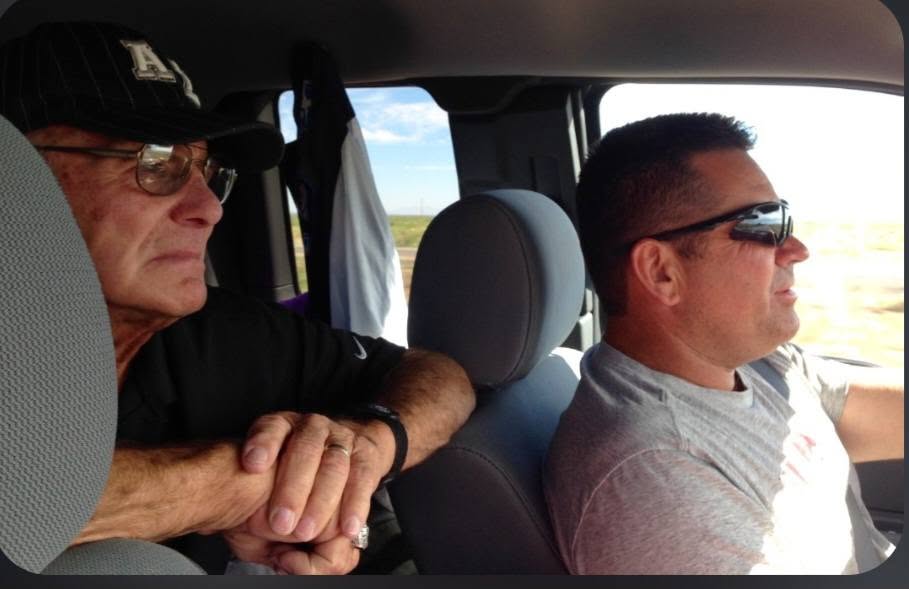
Portillo coached with Team USA at various age levels and at the high school level in Tucson and New Mexico. He has helped organize free wrestling clinics for youths in Tucson and New Mexico and has helped coach at camps, such as the one at Arizona State last week. He has coached at Amphi and Desert View. He has joined the staff at Catalina Foothills, where he is assisting his Godson Gabriel Maynes, a former standout at Silver High School in Silver City, N.M., where Portillo coached.
One of Portillo’s fondest memories is driving Don and Faith Klostreich to various functions related to wrestling after his former coach’s health started to deteriorate and he could no longer drive.
A drive from Yuma to Stillwater, Okla., included Klostreich presenting Dave “Doc” Bennett, one of his former wrestlers at Jamestown College, his induction into the National Wrestling Hall of Fame.
Another trip involved Portillo taking Klostreich to Los Angeles when Portillo was on the Team USA World Cup staff in 2010. It was like taking a kid to Disneyland, only the old coach got to meet other wrestling legends.
“He sat with (Hall of Famers) Dan Gable, Tom Brands and Brandon Slay, and then the next morning we had breakfast and (former Oklahoma State coach) John Smith and (Cowboy wrestling great) Eric Guerrero sat with us — Olympic champ, one of the best U.S. wrestlers,” Portillo said. “And then (Penn State coach) Cael Sanderson and (Penn State assistant and two-time national champ at Iowa State) Jake Varner sat with us. Then, the next thing you know, the whole World Cup team is sitting with us.
“The next day, he was like, ‘Where am I going to sit?’ I was like, ‘You’re going to be with me, man.’ So, we go into the locker room and he’s listening to rap music, talking to Jordan Burroughs, Olympic champ … (Oklahoma State two-time national titlist) Jordan Oliver … he’s looking at me smiling and just having a good time, giving me a thumbs up. That was one of the best times he had, he told me.”
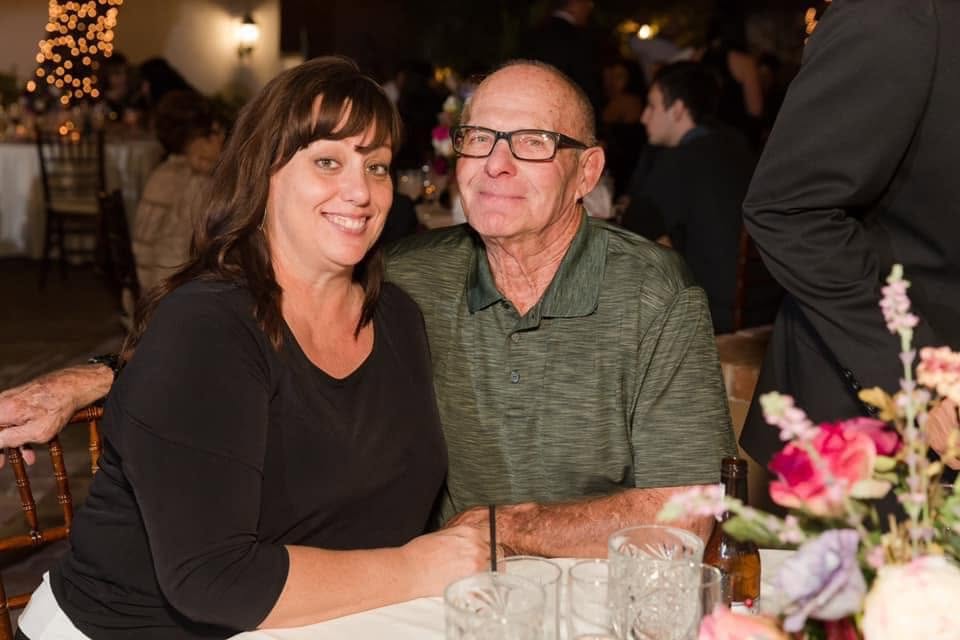
“(Klostreich) went to college and discovered that what had felt like deprivation had really been training. While others wilted under pressure, Don rose above because he’d already spent working in conditions (on the farm) that didn’t care about his comfort. He was built for it. He gravitated toward other tough young men, farm kids, athletes, and high school coaches like Ernie Gates and his college coach, Sid Grande, for whom he would have run through a brick wall. Those high school and college years were years of full stride — everything ahead, everything possible.” — Faith Klostreich
Former Sunnyside wrestler Chris Bonn, who later was an assistant coach under Sanchez with the wrestling and football teams, recalled how Klostreich’s extreme disciplinary approach led to a stronger mindset and future success.
Bonn is a longtime local school administrator and adjunct College of Education professor at Grand Canyon University who now owns his own executive and leadership counseling business.
“We used to have full practices before we went out and wrestled our opponents, and then if we beat them too badly and we didn’t get enough time on the stage, we had to go back in the room and wrestle again,” said Bonn, a heavyweight who wrestled for Sunnyside toward the end of Klostreich’s career there in 1989.
“See, our greatest opponent was never the teams that we were wrestling. Our greatest opponent was ourselves, our minds, and Coach instilled that in us.”
Manny Montaño, a former Sunnyside wrestler coached by Klostreich and Sanchez, spoke about a fond memory he has of his former coaches when he dealt with severe personal trauma, losing both of his parents at a young age.
His mother passed away two years after his dad, when Montaño was a 15-year-old sophomore at Sunnyside.
“I was at my mother’s wake, there with my family, and I was in shambles,” Montaño said. “I watched Coach Klostreich and Richard Sanchez walk in, and I was amazed at how much they cared. They cared for all of us, and at that moment, I realized he was my family. I took him in.
“I erased everything he had to say, all the toughness he had, all the suck-it-ups he told me, all the looks of in his eyes when he looked at you and he was disappointed … you didn’t want to be disappointing him, and even if you won, and you really creamed the guy, he was never happy. We always tried to satisfy him, and that’s one thing I want to take away from this, or give you is a sense of family. We’re all family. We know where we came from. It was a toughness. It was a dedication. It was the discipline. It was showing up every day.”
Montaño also recalled that when he was at his “lowest point,” right before a match, Klostreich offered encouraging words in his own way.
“He would say, ‘Manny, don’t lay down and die. Don’t lay down and die; you fight with everything you have,'” Montaño said. “I told him, ‘Coach, I’m going to give everything I have,’ and I did, I gave it. I gave it for him, and he became family to me. His family became family to me.
“He saved my life.”
Cesar Ruiz won a state title in 1988 with Klostreich as his coach. They also became closer as the years went on with Ruiz often visiting Klostreich and his family in Yuma.
Ruiz has grown close with different generations of Sunnyside wrestlers because of the sense of family the program has generated.
He mentioned that the legions of Sunnyside wrestlers “should really stop and smell the flowers.”
“I try to every day,” he mentioned. “Why? Because more and more, I realize how special we really are on the Southside.”
Ruiz is leading the charge for Sunnyside to name its soon-to-be remodeled wrestling room after Klostreich. When that was announced to the crowd Saturday, it was met with a standing ovation.
That would be an apt way to honor not only Sunnyside’s most legendary coach, but one of the state’s most distinct coaches when it comes to a never-ending impact on a program and community.
Faith Klostreich’s speech at the event tugged at the hearts of Klostreich’s many former wrestlers and others affiliated with the program who were in attendance. Klostreich’s former assistant coach Chris Antoniotti, who coached Desert View to three state championships, was one of the many significant wrestling figures in attendance.
She mentioned that Klostreich tried to be successful by associating himself with tremendous people, and when she mentioned Antoniotti’s name as one of them, the room erupted in cheer.
Antoniotti rose from his seat to a standing applause.
Klostreich’s spirit had to be smiling through that trademark glare of a general.
“Winter on a farm is not an ending. A farmer knows that winter is rest. Winter is the quiet work beneath the surface. Winter is what makes the rebirth of spring possible for a man of faith. Winter is simply the last season before something we cannot yet see, but something Don, I believe, is already experiencing. This farm boy from North Dakota lived a full life every season with his whole self. He endured what most couldn’t. He built what most wouldn’t. He loved deeply, fiercely, and in the end, tenderly, in the way that only the strongest people can. To everything, there is a season. Don lived them all. Rest now, Coach. The field is good. The work was worthy, and we will carry it forward.” — Faith Klostreich
FOLLOW @JAVIERJMORALES ON TWITTER!
ALLSPORTSTUCSON.com publisher, writer and editor Javier Morales is a former Arizona Press Club award winner. He is a former Arizona Daily Star beat reporter for the Arizona basketball team, including when the Wildcats won the 1996-97 NCAA title. He has also written articles for CollegeAD.com, Bleacher Report, Lindy’s Sports, TucsonCitizen.com, The Arizona Republic, Sporting News and Baseball America, among many other publications. He has also authored the book “The Highest Form of Living”, which is available at Amazon. He became an educator in 2016 and is presently a special education teacher at Sunnyside High School in the Sunnyside Unified School District.













Recommended for you